Showing posts with label Ghana. Show all posts

Thursday, October 19, 2017

Training citizen journalists to engage their communities for development

I haven't written a blog in so many years. I have been busy with Ghana Business News and NewsBridge Africa, the not for profit journalism skills training organisation that I started on returning from Columbia University in 2014.

In August I received a call from an official of the Media Foundation for West Africa (MFWA). The organisation wanted to know how available I will be to undertake a one-month training of citizen journalists across four districts in four regions of Ghana.

I was excited about the prospects. Training others is my passion, it's one of my long-term goals. They asked me to block the whole of October to be able to do so. I obliged and cancelled all other engagements so I can be available to do the training.

The first training scheduled to run for three days was set in the capital of the Twifo Atii Morkwa District of the Central Region, Twifo Praso.

From October 10 to 13, 2017 I travelled with the affable Adiza Moro Maiga, the Programme Officer for Media, Development and Democracy at the MFWA to Twifo Praso to meet an eager group of 10 men and women waiting to learn the ropes - to acquire the skills for citizen journalism.

I prepared to teach about using some social media tools like blogging and tweeting to engage the communities. I taught them basic communication and writing skills, showing them a good number of examples and scenarios they are familiar with, so the ideas can be cemented.


By the end of the third day, most of the participants have learned how to create a blog. They also created Twitter accounts and posted their first tweets!

Most were excited, and felt some sense of accomplishment. Most said they have learned new things for the first time and will be happy to apply them.

The journey is long, the training goes on till the first week of November. After a couple of days break in Accra, we set off on daily trips to the Tema District near Accra for the second segment of the training from October 17 to 19, 2017. Here in Tema, the group of participants were not different from the participants we met in Twifo Praso. Eager, willing and ready to learn.


We took off as usual building a connection with the group, building their confidence and trust in us so we can impact and equip them with the skills they need to be citizen journalists.

They are lapping on the information and trying their hands on the new skills of creating a blog, creating content and tweeting.


The importance of this training programme cannot be overemphasised and hopefully, if the participants, in spite of the challenges, pursue their passions and apply the skills, they are very likely to become influencers in their communities.

Our next stop is Ellembelle in the Western Region and the last district we shall be heading to at the end of October is Wa in the Upper West Region.

The entire one month training is under the hashtag #Mycitizenjournalist. You can follow that on Twitter.


Wednesday, August 27, 2014

Ghana’s media landscape is cloudy, time to consider non-profit news


By Emmanuel K. Dogbevi
Image Source: European Parliament

Ghana to a large extent used to have a strong and dedicated news media that pursued high standards
of professionalism in news gathering, packaging and dissemination soon after independence and during the 1980s. These periods were difficult both during civilian and military dictatorships but most committed journalists and publishers stood true to the principles and ethics of the profession.

In their book, ‘The Elements of Journalism’, Bill Kovach and Tom Rosenstiel have argued that changes in politics, technology, culture and taste have occurred in the world around us requiring that journalists adapt to the changes without abandoning the elements of journalism that remain fundamental and enduring.

“To survive, journalism must adapt in form and style to reflect changes in culture, politics, taste and technology. But as journalism changes, those who produce the news also must keep in mind the purpose and principles of producing accurate information on behalf of the citizens.”

Meanwhile, a cursory look at Ghana’s news media landscape today shows a cloudy, shady news ecosystem. Generally, the news is shallow, one-sided, and often not the news at all.
This situation is prevailing in spite of the fact that the country has been practicing democracy since 1992 and Chapter 13 of the country’s Constitution stipulates in very elaborate terms and unambiguous language the freedom of the press. A freedom, unfortunately that seems not to be exercised fully by news practitioners that it seeks to protect, eventually making space for nonprofessionals with no news gathering and disseminating training or skills to hold sway, creating the impression that anyone with a good voice, good looks, a command of language that might not necessarily be good and could scribble away something or anything to put themselves up as journalists.

The act is so inundating to the extent that good quality journalism has been eclipsed.
There are hundreds of private FM radio stations and several hundreds of registered newspapers and almost 20 TV stations, but not much positives can be said for particularly the news component of these organizations.

What can be referred to as good quality and professional news is sparse and far in-between. What is news in the professional sense is not often covered well, and not enough is being done to enhance news coverage in ethical and professional ways, because most of the news organizations are owned by politicians both in the ruling party and opposition. Depending on which political party is in power, its supporters and influential members are allocated radio and TV frequencies and they often seem to have the financial capital to invest in media organizations. This development has become costly for a country like Ghana that is struggling to figure out a development path, because often the facts are clouded and judgemental, and depending on whose interest is being served, the facts are skewed in that direction with little or no commitment to ethical demands of journalism and the pursuit of truth.

According to Kovach and Rosenstiel, “Journalism provides something unique to a culture: independent, reliable, accurate, and comprehensive information that citizens require to be free. A journalism that is asked to provide something other than that subverts democratic culture.”

The news organizations seem to have become unsuccessful in performing their role as ‘Fourth Estate of the Realm’, even with the obvious ineffectiveness of the country’s often ruling party dominated Parliaments to hold the Executive in check - a situation that in itself should compel the journalist to rise up and play the watchdog role with zeal.

 Parliaments in Ghana are on record to have passed into law questionable agreements and have also in some cases rushed to pass laws without adequate debate or enough information to the public. A case in point was the repeal of a 1974 law making right-hand drive vehicles illegal and the passing of the law to make genetically modified organisms legal in the country. Some questionable sale and purchase and loan agreements have also been passed without much information to the public – literally behind the back door.

What has also become common is that most of the news organizations do not seem to probe deeper into and rigorously question political decisions and actions of government and the opposition as required by the tenets of journalism. Often, it is the word of one government official against an opposition figure and often outright falsehoods are carried in the news without cross-checking simply because a public official has said so. Most news organizations have simply become platforms for propaganda and the spread of often suspicious official views.

Some companies put out misleading advertorials that get carried by news organizations without any questioning because majority of these news organizations are commercial entities and they depend largely on advertizing revenues to stay in business.

The incidence of businesses using advertisement as a control tool to get news organizations to feign ignorance when they flagrantly abuse laws and regulations governing business practices in the country is on the increase. Some news organizations that expose the misconduct of companies are denied advertising.

In the past for instance, it was common practice for news organizations to vet advertisements and if they do not meet the ethical standards of these organizations, they would reject them, but not anymore. Adverts that are in obvious contravention of laws such as the food and drugs law, the safety of children and public morality are accepted for broadcast and published by some of these organizations.

Knowing the importance of advertizing revenues to the sustainability of these news organizations, some company executives are known to regularly threaten news organizations with withdrawal of advertisements on account of publishing factual information about their operations.

Some outstanding journalists have lost their jobs for insisting on publishing the facts against the wishes of their employers, while others have had to quit their jobs because they couldn’t ignore the facts and kill stories that owners and marketing officials of the organizations do not want to see published even when all the professional conditions for doing such stories have been fulfilled.
Other journalists sometimes kill stories half way and after completion or they simply do not look into them after receiving primary information.

Ghana no doubt has very highly trained journalists and some of them can stand at par with the best in the world. Indeed, some have excelled in various beats both at home and abroad including receiving prestigious global journalism fellowships at Ivy League institutions. The bigger picture of journalism in Ghana is not a true reflection of the caliber of journalists working in the country, it is a reflection of media ownership and the large number of news organizations established not for the basic principles of journalism but for profit and in most cases for political purposes only.

That being the case, one possible way out of the depressing quagmire is to consider non-profit news. Non-profit news has been used in most developed countries to pursue what has become known as crusading journalism. Non-profits are set up for the single most important purpose of publishing the truth in the public interest and non-profit news organizations are not encumbered by the parochial interests of politicians and the corporate world and therefore exist to serve the greater interest of the public to know the truth.

Kovach and Rosenstiel say journalism’s first obligation is to the truth; its first loyalty is to citizens; its essence is a discipline of verification; its practitioners must maintain an independence from those they cover; and it must serve as an independent monitor of power.
They add that journalism must provide a forum for public criticism and compromise and must strive to make the significant interesting and relevant.

At this very crucial stage of Ghana’s nationhood, where in spite of constitutionalism, there is very little transparency and accountability, the need for non-profit news organizations has become more important.

The role of journalists in holding governments and their allies in the corporate world to account on behalf of the people cannot be overemphasized and no strings attached non-profit news organizations could be one of the important players in this regard. Journalists should be able to do their jobs without fear of offending political figures or business people whose interests their employers serve or on who they depend for sustainability. They should not be compelled in doing their jobs to favour any individual or groups, but the truth.

Due to the suffocating influence of nonprofessionals on news, it is so hard at this moment to get a good, fair and balanced idea of the state of affairs in Ghana by looking at the newspapers, listening to radio or watching TV. Facts are often not facts by and in themselves but because someone, most often a public official has said so. And despite the strong belief and perception of growing public corruption among Ghanaians, news reports about corruption are often denied by public officials or their assigns making journalists and news organizations look bad, and not many of the reports exposing corruption can be proven because most of these reports are either one-sided or not dug into efficiently, often leaving more room for doubt. Additionally, not many of the so-called ‘revelations’ can stand as evidence in courts of law.

While, there is consensus among Ghanaians that the journalist is important in the pursuit of a progressively accountable and transparent society ran on good corporate governance principles, one way to empower the journalist to play that role is to consider the provision of funds or a source of funding to enable not-for-profit news outlets to play that role.

Friday, August 15, 2014

Africa, Ghana rising? Whose Africa? Whose Ghana?

By Emmanuel K. Dogbevi

Some citizens protesting bad governance and economic decline in Ghana.
Only as recently as 2012, Africa was in focus as the world’s economic rising star. The continent posted very healthy figures in GDP growth over a decade. Foreign direct investments (FDI) rose, there was growth in real estate development and declining inflation.

In 2012 for instance Chinese contractors were reported to have had a turnover in housing in all 53 African countries to the tune of $40.8 billion, and the top three countries were Angola, Nigeria and Algeria, accounting for 41.7%.

These were record investments in Africa, and the economies of some African countries were feverishly and ecstatically rebased to reflect ‘realistic’ economic data.

When the list was drawn for the world’s 10 fastest growing economies in 2012, about seven were African countries including Ghana and Eritrea.

Never mind that Eritrea is one of the poorest, conflict ridden countries on the continent and it is ruled by a suffocating and ruthless dictatorship with a nauseating record of haunting and hunting down its own citizens, but nonetheless it made it to the list.

Ghana’s economy in 2011 grew almost 14.4% and inflation dropped to about 9%. The country became a good example of democratic success on the continent, as if to say democracy necessarily stimulated economic growth.
A sign announcing Ghana's capital Accra as a Millennium City.
The broken texts reflect the mismanagement and neglect of the country's economy and infrastructure.

Incidentally, one of the factors that put African countries in focus was the fact that the developed countries were struggling to recover from the ripples of the global financial crisis of 2008 which was precipitated mainly by the housing and banking industry in the US. African countries luckily were untouched by the devastating effects of the crisis, for the simple fact that the financial systems of the countries on the continent were not well developed as that of the west and more importantly, these economies were not integrated into the financial systems of the west.

Ghana, for instance had just rushed into producing oil, and the investments in oil infrastructure had boosted the economy, but sadly that was soon to be seen as a flash in the pan. The country suddenly entered an election year, and the records show that in every election year the country’s economy runs out of control due to government over spending. There was also the case of poor planning riddled with so much ‘political expediencies’, short sightedness and lack of political savvy, and just after 2013, the country’s economy started to show rapid decline.

Whatever the western media saw to start proclaiming the rise of Africa is hard to tell. May be they were looking at the figures - it could also possibly be that they were doing penance. The western media might have been moved by guilt to start singing the chorus of Africa rising after having spent several decades declaring the continent hopeless and dark.  The media probably felt it owed the continent ‘fair’ and balanced reporting, and the continent’s leaders lapped it, including academics. Not many questioned the data. The few who tried to be skeptical were labeled, blacklisted and somehow punished in subtle but notable ways that showed that everyone believed in the data or at most, didn’t want to probe further to ascertain the veracity of the data. “Numbers don’t lie’ some argued.

But the growth like a bubble didn’t last long and burst. In the case of Ghana, long before the government of the day began admitting there is decline, the same western media is already hammering the economic decline which is now dimming the faint glimmer of hope that most of the country’s poor held when oil was discovered.

Ghana has been touted as the continent’s great example of a modern democracy on a continent ravaged by conflict resulting from electoral disputes. But long before the country was raised and praised as an adorable symbol of democracy, some Ghanaians who observed the system critically pointed out that the country’s democracy was a façade. The closest the country had got to a democracy was to organize elections and announce results. Despite evidences of rigging and intimidation of citizens and the media during electioneering activities, long-suffering citizens have always accepted the final results as announced by the country’s electoral commission for the sake of ‘peace’.

Results of the 2012 presidential elections were disputed and eventually went to the Supreme Court. After several months in court the matter was settled and the opposition accepted the outcome. The Court declared the incumbent government winner.

Incidentally, while Ghana is considered one of the countries in Africa with free expression and a free press, journalists are often intimidated, and while it’s hard to prove, a few influential ones have been bribed into burying facts and instead they trumpet and defend propaganda.

Majority of media organizations are owned by politicians and their allies, and media organizations that follow the professional path are punished by being denied advertizing and sometimes accreditation to cover national events.

The façade is so glaring but as usual, most people are playing the ostrich.

Now the country seems to almost hit rock bottom. The budget deficit continues to widen, becoming a major constraint to fiscal and debt sustainability and the government has turned to the IMF for help. But if one listens to both the president and the finance minister, it is hard to tell what the government has gone to the IMF for – however, the suspicion and belief among most citizens is that it has gone to the IMF to seek a financial bailout, and other citizens have suggested it is a subtle way to reign in government expenditure and bring about fiscal sanity based on IMF conditionalities.

Perhaps the western media was too quick to praise the continent and that might have gone into the head of its leaders, most of who recorded evidences has shown to think more about the power they grab and wield, much more than creating wealth and ending inequality.

Don’t tell me Africa is rising yet. I live in an African country, I will know when it does, and while we are at it, there goes Ghana, already losing her shine.

Thursday, July 10, 2014

Occupy FlagStaff House protest must be signal to all political parties


By Emmanuel K. Dogbevi


The significantly historical protest of July 1 2014, called #OccupyFlagstaffouse should be a signal to all political parties in Ghana. 

The die is cast and Ghanaians won’t sit down and watch a motley collection of people come together to form political parties, ride on the back of the Constitution, mislead Ghanaians, get citizens to vote them into office, and then they spend time taking care of themselves and paying eternal debts to their cronies and sponsors.

Since Ghana adopted Constitutional democracy, the conducts of politicians before and during electioneering campaigns have been consistently inconsistent with their conducts as soon as they are elected into office. They become tin gods and only seek to fill their bellies. It becomes like they said in Kenya ‘time to eat’.

The fact that the Ghanaians who joined the protest in the face of vulgar police intimidation and the outpouring of rains shows a people now determined to strongly tell political office holders that occupying political office is a responsibility and not a favour. Political office holders in this country live in free housing, have luxurious cars at their disposal, draw free fuel and have police escorts protecting them at the expense of the people and yet they are unable to address the economic realities of the times. They now call these issues ‘challenges’ as if to say they are unavoidable and therefore, can’t be resolved. 

Most Ghanaians are simply appalled by what has become the standard of public service in this country – which is simply talking, while they enrich themselves under very strange circumstances. 

As they do, most ministers of state spend a large amount of the time at their disposal talking on every available air time in the country, and often repeating themselves sick, without any substance. What is worse, they are lying and spewing inconsistencies as if Ghanaians are undiscerning. 

Ministers of state are falling over each other to be noticed -  and they do that by seizing every opportunity to talk, as if that’s what they have been appointed to do. It’s mindboggling to consider the amount of time these public officials spend talking instead of doing the actual work they have been appointed to do and are being paid for, with all the luxurious pecks that come with it including traveling First and Business Class.

Notwithstanding the fact that the evidences of their ineptitude and non-performance are becoming legendary, they are paying hirelings to do hatchet jobs for them by maligning decent citizens.

You contested an election and won, now you must work. All the ‘challenges’ are yours to deal with, that’s what you are in public office for. Stop acknowledging and telling us about the ‘challenges’, the depreciating cedi, the irrational foreign exchange directives, the high inflation rate, talking of rising inflation I remember when ‘single digit’ inflation was sung hoarse into our ears as if it was such a great achievement of government. Now it’s rising and it is ‘challenges’. Only yesterday, the Central Bank which approved the withdrawal of millions of dollars which was sent to Brazil in a manner one can simply describe as irresponsible and objectionable increased the interest rate to 18%! Is the government taking responsibility for that? As it did when it was falling?

That period is over, when Ghanaians mostly sat back and threw their hands up in desperation, now they are willing to hold public office holders to account, and this won’t change, no matter which political party or politician is in power. 

I have never gone on a protest in my life, not even when I was a student at the University of Ghana at a time when the ‘MOBROWA STRUGGLE’ was launched to protest increase in tuition fees. But I feel proud and gratified that I joined this protest! I will forever feel I had paid my dues to the country and my conscience for joining the hundreds of Ghanaians out in the rains who were also confronted with the glaring possibilities of state sanctioned police brutality. While the conduct of the police was generally professional, there were some isolated cases of attempts by some officers to provoke protestors so they could possibly use the occasion to be violent against them, but as good reason prevailed, the protestors did not fall for the trick.

It was the only time I wasn’t at a protest as a reporter. I was there as a protestor demanding responsible governance – it is one of the many apart from my writings and journalism that I could give to a great country, that has been brought down to her knees and made into a laughing stock by people into whose hands we have entrusted our destinies.

And let the other political parties take note that it won’t be different no matter who is in power, the downward trend the country has been going must come to a halt at some point, and we the people will demand that through all constitutionally guaranteed means.

Get to work, deal with the ‘challenges’ that’s what you are elected and appointed for. We demand accountable, responsible governance, enough of the propaganda and communist inferior tactics!

Let those who can read, understand the signs of the times.

#OccupyFlagStaffHouse #RedFriday 


Wednesday, February 12, 2014

My snow boots, ghanabusinessnews.com and me

 By Emmanuel K. Dogbevi

It has been snowing in New York City for over six weeks now. I am told it is the harshest winter the City has experienced in about 20 years. It has been inconsistent though, with intermittent sunshine and sometimes sleet rain.

It is my first experience of snowy weather and the first time that I physically saw and felt snow. The first time it snowed early in the morning, I peeped throw my window excitedly. Apparently, I wasn't the only adult fascinated by snow. When I went out that evening I saw some adults playing and rolling in snow. I also collected and took some snow home!

Well, if you haven't seen snow before, look into your fridge or freezer, the ice flakes you see in there closely resemble snow, and if you have ever been in a butcher's storage facility, it feels something like walking in snow.

When in September I was advised to get a snow boot as I would need it, I spoke to a friend in Europe about it, but this friend said, I didn't need a snow boot. "You should be fine with your sneakers," the friend said. But I realised sooner that indeed, I needed a snow boot. Wearing a snow boot when it is snowing or raining of sleet isn't the same as wearing an ordinary pair of shoes or sneakers.

Anyway, I went ahead and bought the snow boot. The popular brands on the market are quite pricy, so I searched hard till I got one that was reasonably priced and I bought it. My earlier hesitation to get one was also due to the fact that I wouldn't need it when I go back to Ghana. But I am glad I got it finally. It is insulated and is made of some rubber making it waterproof and it keeps the feet warm. The other day I stepped into sludge without knowing and I was fine. An ordinary shoe or sneaker would have been soaked and I don't want to imagine how cold my feet would have felt that evening on 114th Street on Broadway.

The winter is getting grimmer, but I am getting used to it and having a snow boot increases my chances of attending classes and getting into town whenever it snows and I necessarily have to go out.

And for some of you who might know about the business news website that I started five years ago, it has been offline. ghanabusinessnews.com has gone offline temporarily.

I have received several mails including phone calls from some visitors to the site expressing disappointment over the shut down. It wasn't an easy decision to make but it was the only reasonable one under the circumstances.

Meanwhile, as the calls and mails that I received from some of the readers emphasised the importance and relevance of the site which incidentally though, is the only major source of business news out of Ghana, that view did not reflect the position of the advertising community.

The site has to be suspended because of rising costs of running it from a shoe string budget that largely had to come from me, after I have sunk my entire savings into starting and running it after sometime.

Over the five years that the site has been running, traffic has been growing exponentially, and the database has also grown, requiring bigger more efficient servers and services that my meager resources are unable to finance any more. I have become tired depending on the goodwill of some friends and family who have been very supportive along the way. It became impossible to hire skilled writers and programmers because the site does not generate revenue - it is not breaking even.

The business model based on pursuing good quality journalism, building high traffic and then generating revenue from advertising didn't seem to have worked.

The site indeed, achieved remarkably high respect and acceptance worldwide, evidenced in some modest achievements for myself and some of the people who have been working with me, making sacrifices to keep it running. We have been invited to cover and participate in international meetings, workshops and press conferences. Articles on the site also won national awards including an international journalism fellowship - the Knight-Bagehot Fellowship in Business and Economic Journalism at the Ivy League institution - Columbia University in the City of New York.

Since the suspension of publishing of the website, I have been reflecting deeply over not only the future of the site, but the future of journalism in Ghana. Any objective observer of journalism in Ghana in general and business journalism in particular would know that all is not well. Not much can be said of the quality of journalism in Ghana, despite the presence of some very well trained journalists and good editors.

Notwithstanding a constitutional provision that gives journalists protection and the freedom to do their work, most journalists are unable to exercise those freedoms without any encumbrance because the dynamics of media ownership makes it impossible to do so. Most owners of media organisations have more political rather than journalistic goals for establishing these news organisations and they mostly use them for their political objectives, and this has reduced discussions in the media to partisan levels. It is more impracticable for most journalists to focus on news worthy issues, write critical and probing editorials than for them to focus on what politicians are saying or have to say on issues even if what they have to say is foolish.

The least said about the state of business news the better. Business newspapers or business news segments on radio or TV are mostly public relations or advertorials promoting one product or company or some business person. For instance, most news organisations carry what they call 'Stock Exchange News' that only report the stocks for the day. There are hardly any critical and objective examination of company stocks or conduct of stock brokers.

Another example is the fact that, even though Ghana has found oil and has been producing oil in the last three years, there isn't a strong focus and adequate informed coverage of the sector. Most of what is published about the oil sector is often from oil companies themselves or government, even though there are more questions than answers in the oil sector - there is no transparency, nor accountability either by government or the oil companies, both operating offshore or onshore and there is corruption.

The six telecoms companies operating in the country are having a field day ripping off subscribers and providing poor quality service. Vodafone, which bought the state-owned Ghana Telecoms including fibre optic facilities that the government has invested in has now decided to curtail access to broadband Internet to subscribers by 'capping' Internet, eventually making excessive profits. It has also failed to expand landline services in the country, in spite of the fact that it is one of the terms for selling the national carrier to it. But Vodafone's conduct is not being scrutinized in the media.

Journalists dare not probe into the activities of these companies or they would threaten to pull out advertising from their organisations, often leaving the 'small fishes' at the mercy of journalists. Not that 'small fishes' should not be exposed when they break rules and endanger everyone else, but there must be fair coverage under all circumstances - which isn't the case. For instance, it is more likely that a rich and well connected person could commit murder and it would never make the news even if journalists get the information - but more likely to see a poor unconnected 'petty' thief exposed and when arrested sometimes, paraded before TV screens and in newspapers.

As the site goes into hiatus, I am looking forward to exploring further, other means of making it sustainable and then reviving it, even though, after working for 23 years as a journalist and contributing extensively to the global information database and to my country, I don't know how many people I have touched or inspired in my career path, but I do hope that I have somehow touched some people and inspired other journalists. Sometimes I feel that I have done my part - like the Akan proverb says, "humans came to play their parts and not to do all."

Monday, January 20, 2014

Komla Dumor is gone, but what he stood for still remains

This week Ghana, Africa the world and journalism lost one of their finest, Komla Dumor of the BBC.

He was a friend and a brother. Whenever we met we called each other 'my brother'. The last time we met, we were both in Addis Ababa, Ethiopia as guests of the UNECA. 


His departure this week has left all of us hurting. Guest blogger and fellow Columbia Graduate School of Journalism mate, Raymond Bayor writes a tribute to the memory of Komla.

I'm sure Komla Dumor's death—a tragedy that we are all still grappling with—has cast our minds and imaginations in different directions. Earlier yesterday, I woke up to scores of phone calls from friends in Ghana, wanting to know if I had heard about his alleged death. I was tempted to dismiss these calls in an instant, but not when these calls were alarming. I went back and forth on phone, frantically trying to verify what looked like a wild rumor, something I'd rather hate to believe. It came to pass that in their millions, our hearts would remain seared for days and months, if not years, in the flames of the anguish resulting from his untimely departure.

Yes, Dumor attained great, enviable heights at home and abroad. He and a few others--no need to mention their names—excelled where many journalists in Ghana would easily fail today: Rising above the pettiness that's bent on ruining our media landscape. They would ask all the bold, embarrassingly probing questions, whether the issues at stake were about SSNIT or a hotel that a sitting president had interest in.

Thousands have taken to social media platforms to pay glowing tributes to one of the world’s finest broadcasters, but what is the state of journalism in Ghana today? If he was an adherent of the caliber of journalism that’s holding sway in Ghana today, would he attain the pinnacle of his career? For some of our colleagues, the line of distinction between news and hearsay is either blurred or does not even exist at all. We have become willing accomplices to condemnable acts—the very things that we must fight with passion.

Journalism is a calling. And this calling to speak can be a vocation of agony. It’s not a shortcut to fame and influence; neither is it an opportunity to settle personal scores, given that there are ethical boundaries within which we operate, whether in Ghana or around the globe. It’s time the Ghanaian journalist accepted that good journalism is no luxury. Of course, the ability to speak to power, subject politicians to the fire of accountability and pursue the cause of the larger society can never be the preserve of the fainthearted.

Journalism that's not principle or truth-driven is but a means to an end that only those who champion it know. If we all paused and reflected upon our approach to our calling to a profession revered for its nobility, especially in relation to the late Dumor's record, would our nation not be better? The image of journalism in Ghana today, unfortunately, is so battered by a strand of laziness, blatant partisanship and professional misconduct. In fact, it’s almost at its nadir.

His painful death, however sudden, leaves us with the challenge to remain relevant in an environment where the intersection of politics and journalism poses a constant threat to the latter's viability as the fourth estate. From the USA, Asia, Europe through to our native Africa, the outpouring of tributes bears eloquent testimony to his enduring legacy, his shortcomings notwithstanding. What do you and I, as journalists, stand for today? Are our actions a fair reflection of our convictions? We have, it’s sad to note, stridden beyond the contours of our watchdog role in ‘lap dogs’!

Our continent still has considerable democratic deficit, fuelled in part by the failure of various governments to commit to core democratic principles. In the case of Ghana, our democratic ‘resilience’ is nonetheless a pride we talk up so well, pretty much to the envy of other Africans. No doubt, our political parties constitute the fulcrum around which our democracy revolves.

What remains to be seen is the capacity of the media to enrich our political discourse. Beyond the obsession with what’s for or against a particular party, which seems to be the new norm now, the national interest can’t be left to fate. Whereas new parties will likely emerge in the course of time, the role of the media is cast in iron, regardless of the governing party. Not until we rededicate ourselves to the sacred values that inform the very being of the profession, we are definitely on a terminal decline. But I pray our image doesn’t get any worse.  “Hope is a waking dream,” Aristotle, the ancient Greek Philosopher, once said.

God bless Ghana.
By Raymond Yeldidong Bayor.
Email: yeldidong@gmail.com

Monday, January 6, 2014

One year of John Mahama’s administration – What’s there to celebrate?

 By Emmanuel K. Dogbevi
 
Since Ghana became independent from British colonial rule in 1957, the country’s social and economic growth has been swinging in no particular direction. Ghanaians have vacillated between hope and despair, with growing doubt in leadership to crippling cynicism.

Ghana today in 2014, is a pale shadow of herself, at the dawn of independence when the entire continent of Africa and the black race looked up to her as a beacon of hope. Hope for black emancipation, a positive pointer to what the black race was capable of doing with self governance as Dr. Kwame Nkrumah aptly captured in his speech at the eve of independence.

“At long last, the battle has ended!  And thus, Ghana, your beloved country is free forever!
And, as I pointed out… from now on, today, we must change our attitudes and our minds.  We must realise that from now on we are no longer a colonial but free and independent people.
But also, as I pointed out, that also entails hard work.  That new Africa is ready to fight his own battles and show that after all the black man is capable of managing his own affairs,” he said.

Ghana’s Ministry of Information has put out announcements to mark John Mahama’s one year in office as president with a public forum.

In the circular announcing the event the ministry noted, “As part of activities marking the first anniversary of the government of President John Dramani Mahama and in line with government’s commitment to deepen transparency and accountability, the Ministry of Information and Media Relations will hold a Public forum on Monday, 6th January, 2014.”

Since the Ministry is speaking of transparency and accountability, it is only fair to scrutinize the government’s performance in the light of the two adjectives.

It is talking about deepening transparency and accountability as if it is already the case, but it is so hard to see how transparent and accountable the government has been.

Speaking of accountability, the government is yet to account for the numerous wrongful payments of public funds to individuals and shady companies headed or owned by well known friends and cronies of the president and his associates – speaking of which, the government has yet to account for the GH¢51 million ‘Judgement Debt’ paid to Alfred Agbesi Woyome a member of the ruling party, in spite of everything known about the deal to be wrong.

The expected refund of close to €47 million in judgement debt paid to Waterville and a little over $300,000 paid to Isofoton, are yet to be done as the matter seems to be entangled in unending legal tussles.

Accountability would have dictated that these monies weren’t paid at all in the first place. And having done so, and found to have been wrong, a government inclined to being accountable to the people who elected it to office to manage the scarce national resources would have mustered the courage, shown good conscience and acted to right the wrongs.

For an administration dogged with so many allegations of corruption and irresponsible use and obvious wastage of public funds, it takes real courage or sheer insensitivity and shamelessness to speak of ‘deepening transparency and accountability’, as if it was already doing so.

There is the outstanding issue of the payment of GH¢144 million by the Ghana Revenue Authority, to an obviously phony company SUBAH - the company purported to have been contracted to monitor mobile phone companies’ revenues. SUBAH has been paid even though the mobile companies have no idea how it was monitoring their revenues. 

Up till now the government is yet to fully tell Ghanaians the rationale for paying RLG Communications, Asongtaba Cottage Industries and Craftpro some GH¢55 million. And while these companies are reported to have committed to refund the monies, an indication which is itself an admission that the monies were wrongfully paid to them, it is not clear yet if they have paid up or even started moves to return the monies.

As if being reckless and unaccountable for the people’s money hasn’t been demonstrated enough, the government is yet to account for how GH¢1 million allocated to the Media Development Fund was misused in unclear circumstances. Sadly the media in Ghana hasn’t been aggressive enough in demanding answers, even after the Information Minister and his deputies have responded with conflicting information following demands by the Media Foundation for West Africa to know how the money was used. The Minister, Mahama Ayariga, apparently had told Parliament that the GH¢1 million was used to purchase RLG laptops for media organizations that themselves have come out to say, they have no idea that it was the case.

After one year, the Mahama administration, has not shown that it is a government focused on working to better the lot of Ghanaians, making its 'Better Ghana Agenda' slogan a fluke. It is yet to show that it intends to manage national resources in its care prudently and responsibly.

It has become so easy to associate the government with corruption and cronyism more than anything else.

Sadly, the government has even gone further in adopting a mafia approach in responding to its critics. It has hired and is paying individuals from state resources to act as hit men and women. They spend hours on radio and TV stations attacking and maligning everyone who criticizes the lackluster performance of a near blasé administration.

The very important Public Interest and Accountability Committee (PIAC), which was established by law to monitor how the country’s petroleum revenue is being used has been deliberately made dysfunctional by government. The Committee has very little and often no resources to work with making it difficult for it to do its work of monitoring how the government is using the revenue from the country’s new found wealth – oil.

When Obama visited Ghana, he spoke of strong institutions, but it is not clear what the Mahama administration is doing about strengthening institutions. There is however, evidence to the contrary, indicating that the government is strengthening its friends and cronies rather than state institutions. The questionable sale of Merchant Bank is one specific example – whose interest is the Mahama administration serving, the nation or its friends and cronies?

Some people have become above the law, not that it is a new thing though, to the extent that they are a danger to public safety.

Prices for public utilities have been increased without corresponding improved services. Water doesn’t flow in most parts of the capital Accra, electricity even went off in some areas on Christmas Day, December 25, 2013.

And when the President came under a barrage of criticisms for his weak leadership, he responded by saying he was lonely, telling his critics if they want to see his back, they should wait for 2016 – the year for another election. Since then he has been talking and acting as though he is still in campaign mood, likely saving up for a ‘war chest’ to fight for another election.

On December 5, 2013 the ratings agency, Moody’s lowered Ghana’s outlook from stable to negative.

According to Moody’s, the cut was due to the Ghana government’s “weak fiscal fundamentals and rising debt levels, which reflect both continued spending overruns and relatively low revenue ratios compared with rating peers, despite rapid growth”.

Ghana’s debt to GDP ratio is reported to be around 50 percent at the end of 2012.

Moody’s noted “the weakening of Ghana’s external position on the back of large external imbalances and a low level of foreign-exchange reserves, which have increased the country’s susceptibility to event risk in view of the strong correlation between domestic economic activity and the global business and commodity cycles”.

A day after Moody’s issued its report on Ghana, another ratings agency, Standard & Poor’s (S&P) also issued a discouraging report on the country. S&P also downgraded Ghana’s credit outlook to negative from stable.

Both cited weaknesses in Ghana’s fiscal stance as it keeps deteriorating.

“The negative outlook indicates at least a one-in-three possibility that we could lower the ratings on Ghana within the next 12-18 months, due to its weakening fiscal and external profile,” S&P said in a statement December 6, 2013.

S&P affirmed its ‘B’ long-term and ‘B’ short-term foreign and local currency sovereign ratings on Ghana.

So far it is not clear, in which the direction the administration which is poised to ‘deepen transparency and accountability’ is leading the country.

Reports on nationwide market fires are still unknown to the citizens whose money has been used for the work – speak of transparency.

The one year of the Mahama administration of the country would go down in history as probably one of the despondent ethos of Ghana’s history. It will also show that most people go into politics with the sole aim to enrich themselves and their cronies at the expense of a docile and acquiescing people.
The excuse that the administration couldn't perform because of the legal challenge of the election result is a 'cock and bull' story. Mahama was not stripped of his presidential powers while the matter was in court, and it would be curious to know if some of the monies paid to now known cronies were paid during this period.

And the least said about journalists in Ghana in general under Mahama’s one year, the better. It is common knowledge that most of them have been bought off with gifts of cars, money and even in some cases, houses. They have failed to hold the government to account. Some of the stories of corruption and blatant thievery that should have been published have been shelved. Some have become advocates of wrongdoing, speaking for and on behalf of the government. They shamelessly have abandoned the ‘High Calling’ for a pittance of bread. They have chosen to accept filthy lucre and turned their back to the noble duty of standing with, for the truth and the voiceless majority. The few who are standing up are coming under great pressure to give up their consciences, accept money and keep quite.

Well, it has been one year of the Mahama administration, and what has been good? Certainly, it is not transparency and accountability.

Wednesday, December 18, 2013

How time flies, some of the things I don't want to miss at Columbia

By Emmanuel K. Dogbevi

How time flies! It's already six months since I moved to New York to begin post-graduate studies at Columbia University and the first semester is already done!

Before I arrived here, I was briefed and adequately told what to expect, but I suspect that some things were left for me to discover by myself and I did. I discovered too soon that having left the classroom for seven years after completing undergraduate studies, it wasn't going to be easy studying at graduate level and in subjects that I have no background in like Financial Accounting!

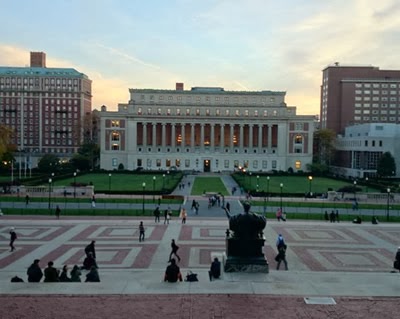
Besides, I took it for granted that I would settle quickly in New York City because of my frequent travel experience only to realize that I wasn’t prepared to suck in the City. It occurred to me too soon that this is New York, 'the Big Apple', I still don't feel at home here and that's in spite of the fact that I live in a very comfortable apartment right in the heart of Columbia University's gorgeous campus at the center of the City.

I am also learning too soon that, one year is not a long time, no, it is not. I have just done six months, and unfortunately, as I look ahead to the end of the programme, I am beginning to feel some amount of trepidation – there were some things I didn’t want to miss out on, but it looks like I might have to do more to avoid missing them. I wanted to fully enjoy the city by visiting all the important places and making new friends, I mean good friends that I can take along the rest of my life, but even though I have met some great people here, had some great lunches and dinners, it doesn’t quite seem to me that I have become friends with these incredible people, maybe I am wrong on this, and I will be happy to be wrong.

So far I have been to only a few places, and not too many of the great restaurants in the City yet. I ate once in Chef Yu’s Restaurant on the 8th Avenue and West 42nd Street and the food was great. I also loved the set up of the restaurant, spacious and comfortable.

Even though I am a student both at the Journalism and Business Schools, the programme is structured in a way that I have to take most of my courses at the Business School, and as a result I am missing out on the Journalism School, something I didn’t expect to happen.

Meanwhile, the Business School has a great active networking strategy, but I feel like I am losing out on that as well. The Cluster and Learning Team systems of the School is a great way to stay connected in Columbia but I don’t seem to have maximized that in as much as I would like to, I had hoped to learn some new things and polish my guitar playing skills while here, even though I had contacted a private teacher to give me private tuition, met a friend who wants us to play jams together on campus, I have not been able to – but I have six more months to go and I do hope to make amends.
And before I am done, I am missing some people already - I am missing my amazing Cluster mates. There are some awesome people in the Cluster who have been so good to me, some have been there for me in very difficult times. I am also missing some of the Peer Advisors (PAs) already even before I am done, wish I could mention names here, but for fear of leaving some names out I won’t even start.

Some of the Professors and Academic Staff do so much to make students go through their studies here smoothly. I have come to know some of them well enough to say they are great people.

At least I can mention the Knight-Bagehot Fellowship Program on which I am privileged to be here. The Director, Terri Thompson and her ever supportive Program Coordinator Gary Hill are never to be forgotten duo. They are doing everything possible to make me and my fellow Bagehots as we are called to sail through the program successfully. And these Fellows are a never to be missed ‘crowd’. Wonderful people to be around, I don’t want to miss the chances of spending much more time with them.

Columbia is a great place to be and I hope to make the best of the second and final semester of the program, so help me God.